01
Local by default
If a feature needs the cloud, it needs a reason. The default answer is no.
DATA STAYS HEREIndependent AI systems lab/Local-first by design
We build AI systems that run on your hardware, answer to your rules, and keep working when the network doesn't.
01 / Flagship
xOS replaces the browser tab with a full-screen cognitive workspace. No accounts, no telemetry, no round trips.
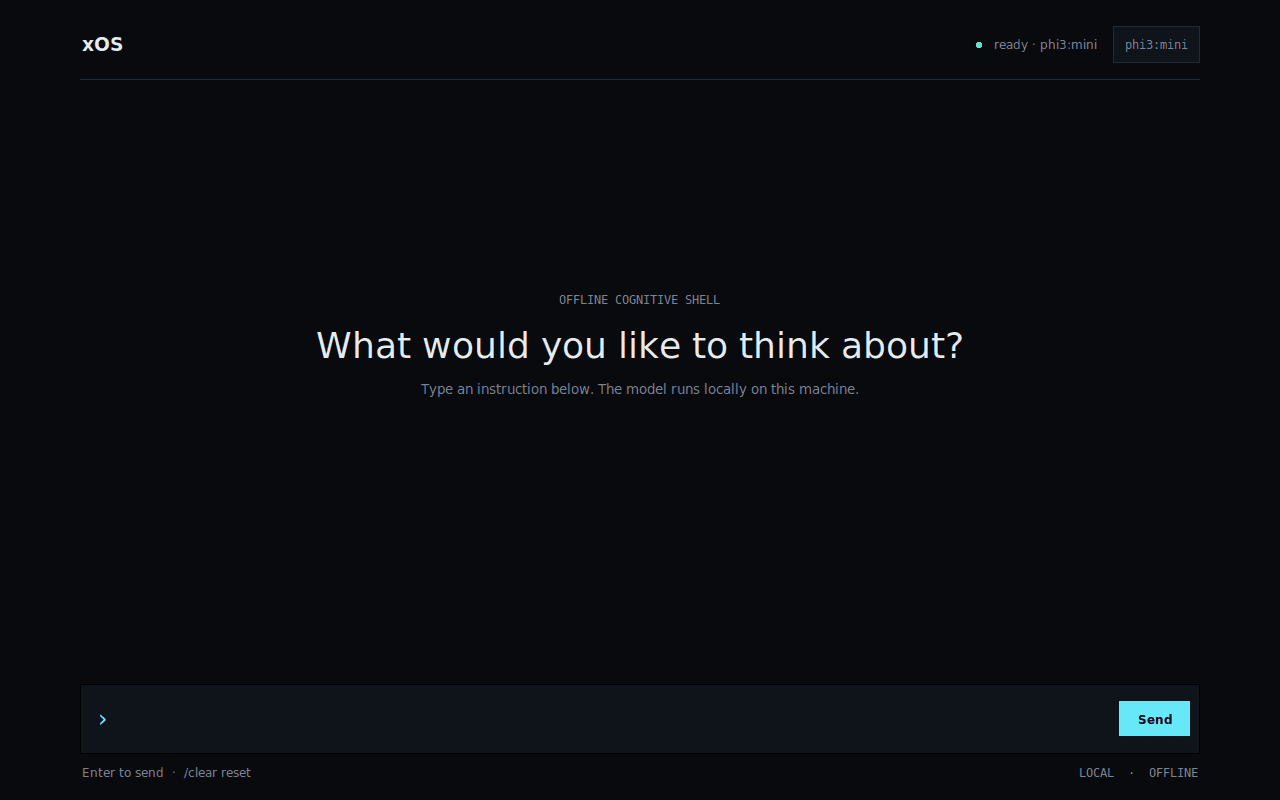
The private cognitive workspace
xOS is a live Ubuntu image built around a single idea: the model should be the only thing between you and the machine. It boots straight into a text-first shell, talks to a local Ollama instance, and keeps every prompt on the box.
Phi-3 Mini runs through Ollama on loopback. No account, no API key, no outbound request.
Xorg, Openbox, and a Tkinter interface. Deliberately small, legible, and fast to start.
English is the default. /language id switches the entire interface to Bahasa Indonesia.
The OS boots from a read-only ISO into RAM. Reboot and the machine returns to a clean state.
Tested in BIOS + UEFI / VirtualBox inference is the next gate / no persistence in alpha
02 / The lab
AIMB-X is an independent lab for systems that trade convenience for control. We think the trade is worth it.
If a feature needs the cloud, it needs a reason. The default answer is no.
DATA STAYS HERENo black boxes in the stack we ship. Every layer should be something you can inspect, replace, or remove.
OPEN TO INSPECTIONFewer layers. Less to trust. More to understand. Small systems are easier to keep honest.
MINIMUM VIABLE TRUSTThe most private data is the data that never leaves the room.
AIMB-X design principle / 001
03 / System
Every part of xOS is chosen for what it does not do: no account layer, no telemetry path, no hidden round trip.
Architecture notes
The shell talks to Ollama over loopback. Ollama loads the model from local disk. The model answers with local compute. That is the whole path.
The runtime binds to loopback. There is no provider key to leak and no hosted endpoint to depend on.
Our QEMU smoke test had 2 GB of RAM. phi3:mini needs roughly 2.2 GB for weights alone, so inference is a separate gate, not a validated claim.
Both firmware paths boot to the kiosk. The ISO is hybrid and boots without a persistence layer.
$ sha256sum xos-alpha.iso
verify before boot → status
04 / Status
Alpha means the parts that work are tested, and the parts that don't are named. This page changes when the evidence does.
fc66ff1408a993dda7db94d25ea3abb68125894e772f0a0580cb62a10403c42505 / Next move
xOS is built in public, on ordinary hardware, with the receipts in the repository. Read the build notes, check the image, or write to the lab.
$ git clone https://github.com/Dracko000/xos.git
$ cd xos
$ cat README.md
$ sha256sum xos-alpha.iso
verify: fc66ff1408a993dd…0403c425
then: boot from the live image.